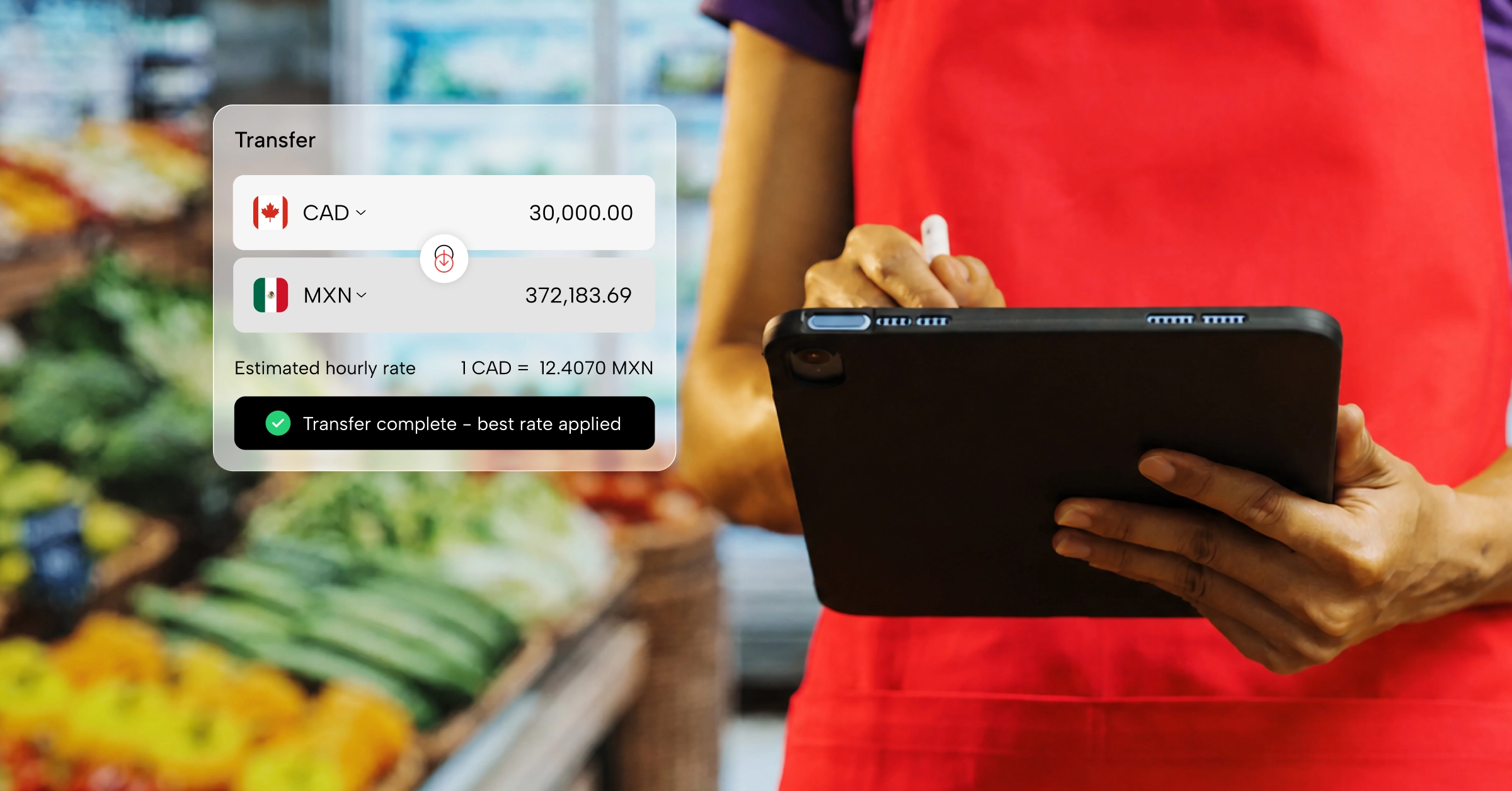
Fresh produce margins are tight by design, especially for US and Canadian wholesale produce importers managing cross-border supplier payments.
In the United States, imports now account for roughly 59% of fresh fruit availability and 35% of fresh vegetables. Canada is also a major importer of fresh produce, relying heavily on cross-border supply chains to meet year-round demand. For categories such as berries, citrus, avocados and grapes, imports now form a core part of year-round supply.
That level of reliance carries financial consequences. For produce import finance teams, FX risk and supplier payment timing directly influence landed cost and margin predictability.
It creates a financial reality most balance sheets do not explicitly model: margin risk often begins weeks before revenue is recognised. For many produce importers, the exposure starts when inventory is booked and supplier commitments are made.
Margin risk between booking and settlement
Consider a typical cross-border produce shipment:
- Contract confirmed in USD
- 20-40% deposit paid at booking
- Balance due upon shipment or shortly after
- 10-21 days in transit
- Revenue recognized after inspection and downstream sale
From a finance perspective, three things have already happened before inventory arrives:
- Cash has left the business
- FX exposure has been created
- Gross margin assumptions have been locked
In cross-border produce imports, that early exposure directly affects landed cost, cash flow and margin planning.
If the supplier is invoicing in USD and the importer earns revenue in CAD, a 2-4% currency move during that window can eliminate a significant portion of expected gross margin.
Even for US importers paying in USD, FX can still influence landed cost predictability when sourcing from Mexico or overseas growers whose cost bases are in other currencies.
Currency movement between booking and settlement is a practical margin issue.
Over the last several years, USD/CAD has regularly moved 3-7% within single quarters. For businesses operating on single-digit gross margins, that movement matters.
Yet many finance workflows still assess FX impact at settlement, not at exposure creation.
Three financial risks in cross-border Produce Imports
Across US and Canadian produce importers, three financial pressure points consistently emerge.
- Prepayments and deposits compress working capital
Deposits are standard in cross-border supplier payments across produce imports.
But when 30% of shipment value is paid weeks before arrival:
- Cash conversion cycles extend
- Liquidity buffers shrink
- Downstream pricing flexibility declines
If inventory is rejected, delayed, or repriced, capital has already been committed.
This reflects the economics of cross-border produce sourcing. Capital is committed well before inventory can generate revenue.
- Currency risk starts earlier than many teams realize
Currency risk begins when the purchase obligation is created, not when the final supplier payment is made.
For a Canadian wholesale produce importer managing USD supplier payments:
- USD liability is created at order booking
- CAD revenue will be recognized weeks later
- The currency risk remains open throughout the transit cycle
If USD strengthens during that window, landed cost increases relative to CAD revenue. Longer transit cycles increase the period during which margins remain sensitive to currency movements.
And early deposits extend that duration further.
Without lifecycle-level tracking from booking through settlement, risk measurement is incomplete. This makes proactive FX risk management difficult, particularly when payment settlement timing is tied to shipment schedules rather than finance calendars.
- In-transit inventory creates margin risk before settlement
Operational teams treat in-transit inventory as moving product.
Finance should treat it as:
- Committed capital
- Open currency positions
- Locked margin assumptions
But in many organizations, visibility into:
- Total cash committed pre-arrival
- Exposure by supplier corridor
- Multi-currency obligations across entities
is fragmented across banks, spreadsheets, and ERP systems.
The result is often gradual margin erosion rather than an obvious operational issue.
Small variances that compound shipment by shipment.
How US and Canadian produce importers manage USD and CAD exposure
While US and Canadian produce importers face similar payment timelines, the financial implications differ.
US importers typically pay suppliers in USD, reducing direct currency mismatch. However, volatility still affects landed cost predictability, especially when pricing decisions are locked before inventory arrival.
Canadian produce importers face a built-in currency mismatch. They often pay suppliers in USD while earning revenue in CAD. This creates a mismatch between supplier costs and customer revenue. If USD strengthens during transit, margins compress before adjustments can be made.
Across both markets, supplier prepayments and deposits extend the period between cash leaving the business and revenue being realized. Cash goes out before revenue comes in, increasing margin risk before settlement. The challenge is not only exchange-rate movement, but also how long those positions remain unmonitored before revenue is realised.
Why produce import finance teams still struggle with payment visibility
Produce importers are operationally sophisticated.
Cold chain compliance is tight.
Supplier networks are long-standing.
Retail pricing negotiations are disciplined.
But financial workflows often evolved around banking relationships, not supply chain tempo.
Common patterns include:
- Payments executed bank-by-bank
- FX managed separately from procurement timing
- Exposure measured at settlement rather than booking
- Limited corridor-level visibility
When payment infrastructure is fragmented across institutions, finance teams cannot easily see:
- How much USD is committed across upcoming shipments
- How long currency positions remain open
- Where same-currency settlement might reduce volatility
The challenge is rarely a lack of systems. More often, finance teams lack a consolidated view of exposure across suppliers, currencies and payment providers.
How currency movements affect landed cost and margin predictability
Let’s illustrate.
Assume:
- CAD importer books $2M USD of shipments per month
- 30% paid at booking
- 70% paid 14 days later
- Gross margin target: 8%
If USD strengthens 3% between booking and revenue recognition:
- Effective landed cost increases
- Margin compresses toward 5%
Across $24M annually, that 3% movement represents $720,000 in margin pressure before operational performance is even evaluated.
For many finance teams, that impact is recorded after the fact rather than managed before it affects margin.
As import reliance grows, cross-border payment risk increases
North America’s reliance on imported produce has trended upward for more than a decade.
Climate variability, consumer demand for year-round availability, and retail consolidation all reinforce cross-border sourcing.
That means:
- More FX-denominated obligations
- Longer supply corridors
- Greater exposure windows
- More pre-arrival capital commitment
These pressures are increasingly embedded in the operating model. Which means financial infrastructure matters as much as logistics infrastructure.
How leading importers manage currency risk and supplier payments
Leading finance teams don't necessarily operate with more discipline. They operate with greater visibility into exposure, liquidity and payment timing.
Finance teams that maintain stronger margin stability across volatile cycles typically:
- Track currency risk from booking, through settlement
- Measure cash committed pre-arrival across currencies
- Align supplier payment timing with shipment milestones
- Consolidate multi-currency balances into one operational view
- Use same-currency settlement where feasible
In other words, they treat cross-border payments and FX as operational infrastructure, not back-office execution.
When finance teams can see risk across the full shipment lifecycle:
- Forecasting improves
- Liquidity planning strengthens
- Margin variance becomes measurable before it becomes permanent
Why payment infrastructure matters for cross-border produce imports
In perishable trade, product risk is well understood.
Financial timing risk is less visible but equally material.
As imports account for more than half of US fruit availability and a growing share of vegetables, the infrastructure behind:
- Multi-currency payments
- FX timing
- Settlement management
has become a strategic part of margin management.
In produce importing, margin pressure often builds between booking and arrival, long before final settlement takes place.
Leading produce importers recognize this. They manage cross-border payments and currency risk as part of their financial infrastructure, with visibility from booking through settlement.
Sokin supports this approach by bringing multi-currency payments and FX management into one platform, helping finance teams monitor payment timing, currency exposure and cash positions before inventory arrives.
By the time settlement happens, much of the margin outcome may already be set. The advantage belongs to finance teams with visibility early enough to act.
See how Sokin helps produce importers manage cross-border payments, currency exposure and multi-currency cash flows from booking through settlement.