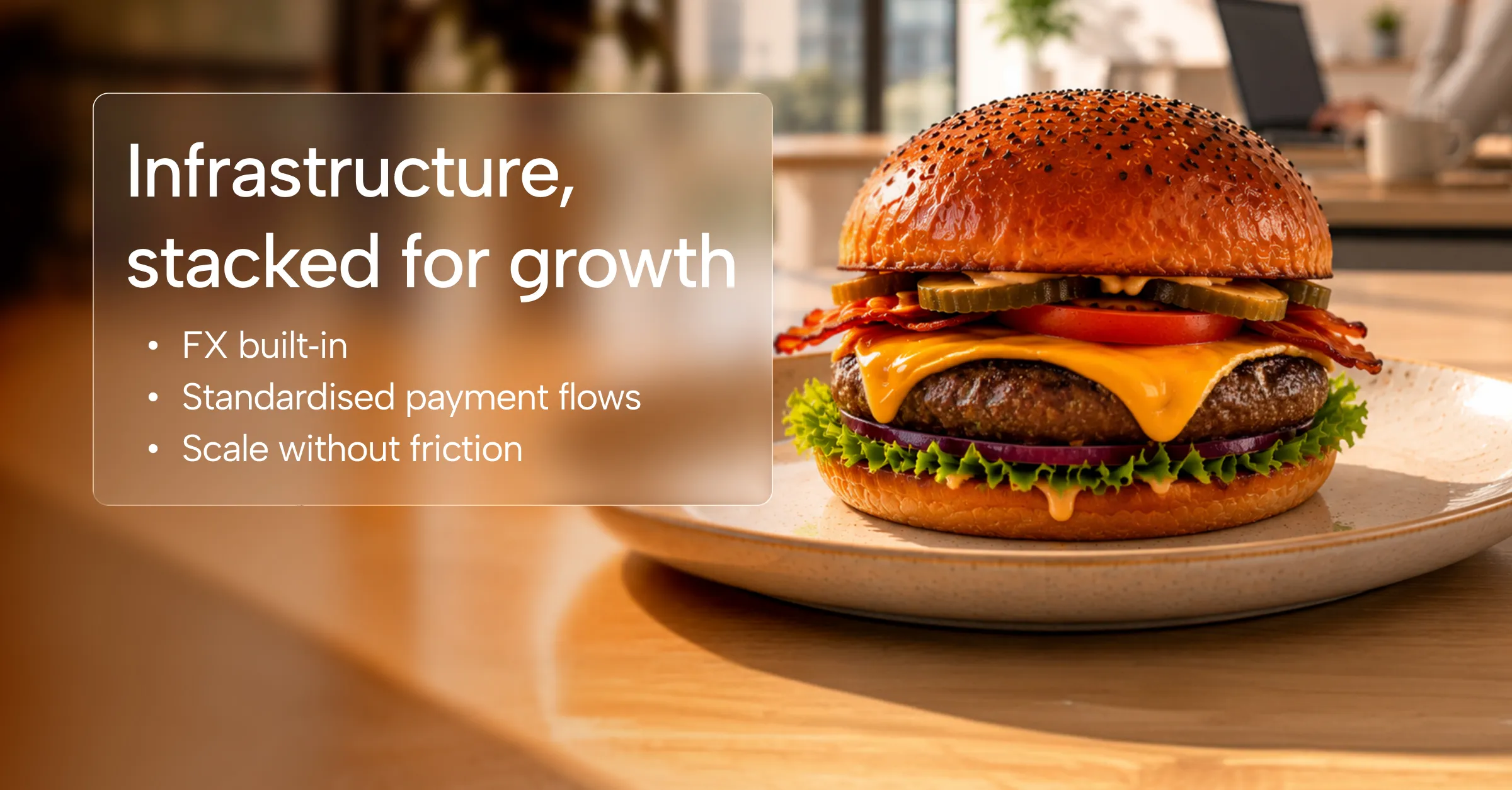
If your global payments setup were a cheeseburger, many finance leaders would recognise the picture: overloaded.
Extra providers. Extra steps. Extra exceptions. All piled on top of each other over years of product launches and market entries. What starts as a simple build ends up stacked so high that the whole thing is harder to hold together.
For CFOs and Finance Directors, the problem isn’t whether payments work. The problem is the operational cost of keeping them working: headcount, reconciliation, delays, and margin erosion that doesn’t show up in the original business case.
This is where embedded global payments and FX infrastructure shifts from theory to fixing how the work actually gets done.
When your payments stack is overdone
Most global payment stacks weren’t designed end-to-end. They were assembled over time:
- A local bank to solve payouts in one market
- A PSP added to support a new customer segment
- An FX provider brought in to “optimise” rates
- Spreadsheets and manual checks to tie it all together
Individually, each decision made sense. Collectively, they create a stack that’s overdone and hard to operate. Think of a burger with too many sauces and add ons. It still qualifies as a cheeseburger, but every bite is messier, slower, and more likely to fall apart in your hands.
- Teams jump between multiple portals to see a single flow from invoice to settlement
- Reconciliation involves matching different reference formats and cutoff times
- Each new corridor or product type requires bespoke logic and one-off workarounds
- Month-end and quarter-end close rely on manual effort and workarounds
It's the operational equivalent of grabbing extra napkins because you know the burger is going to fall apart before you finish it. On paper, money moves. In practice, the cost and complexity of keeping it moving keeps rising.
The CFO’s focus: cost per transaction and cost to operate
Traditionally, payment costs were treated as a line item: fees plus FX spread.
Today, the true cost per transaction also includes:
- Time spent by finance ops and shared-service teams
- Delays that affect working capital and supplier terms
- Investigation and write-offs on failed or mis-routed payments
- The opportunity cost of skilled teams tied up in manual processes
For many CFOs, this shows up as slower cash conversion cycles than the commercial model expects. It also makes it harder to scale transaction volumes without adding headcount, while limiting visibility into the true unit economics of new markets or business lines.
The question becomes: “What would our cost to operate look like if our payments stack had been designed properly from the start?”.
Redesigning the burger: Standardising payment flows for scale and control
Moving to embedded global payments and FX infrastructure is about standardising how money moves across the business.
In practical terms, that means:
- Using multi-currency accounts as a core operating structure, so funds land in a predictable place regardless of channel or market.
- Routing collections and payouts through a more unified infrastructure layer, rather than separate providers and local hacks for each region.
- Exposing that infrastructure via APIs, so payment creation, status, and reconciliation can be wired into existing systems instead of managed in isolation.
You still keep the ingredients your business needs, the equivalent of your bun, patty, cheese, and toppings, but they run on a consistent operational structure that holds together like a well stacked cheeseburger.
Why payment workflows break and how to fix them
The “messy middle” between collection and payout is where many teams lose time:
- File uploads that need formatting just so
- Returned payments because of local field requirements
- Manual approval workflows that live outside finance systems
- Teams chasing status updates from multiple providers
With a more coherent infrastructure underneath, you can push toward straight through processing instead:
- Payments are created directly in your existing systems and sent automatically, instead of being manually uploaded or re-entered.
- Payment updates flow back into your systems automatically, so payments can be matched to invoices without manual reconciliation.
- Exceptions are handled in one place, with clearer reasons, so teams can resolve issues once instead of chasing them across multiple systems.
The outcome isn’t just fewer clicks. It’s fewer failure points and less reliance on manual intervention. It’s a tangible reduction in operational risk and clearer visibility into how transaction volume scales with operational capacity.
Instead of fighting with a messy, overloaded burger, you get something you can pick up, bite into, and trust to behave the same way every time
Why FX costs are an operational problem, not just a pricing issue
FX remains a major source of hidden cost. But in an overdone payments stack, it’s also an operational problem.
When different providers convert at different points in the flow, teams struggle to answer basic questions:
- “What did this corridor actually cost us this month?”
- “How much of that cost was spread vs. fixed fee vs. operational noise?”
- “Are we converting funds more times than we need to, just because of how our stack is wired?”
By consolidating flows into a single infrastructure:
- You can use same-currency settlement where appropriate, reducing unnecessary conversions that create both cost and reconciliation complexity
- You can agree clearer FX pricing structures with providers, so finance can model impact at scale rather than reverse-engineering it from statements.
- You can align FX decisions with operational reality. For example, converting when it best suits your cash‑flow needs, not when a provider’s process forces it
FX becomes part of the operating model for payments, not an opaque overlay.
Scaling volumes without scaling chaos
An overdone stack behaves badly under stress. As volumes grow or new geographies are added, you see:
- More exceptions
- Longer reconciliation cycles
- Increasing dependence on specific individuals who “know how this part works”
Infrastructure-led payments change how scaling works:
- New markets plug into an existing setup, instead of requiring new tools and processes each time.
- Higher volumes don’t mean more headcounts, because more payments run automatically.
- Finance gets a single, clear view of activity, instead of stitching together reports from multiple systems.
This is what stacking your payments for growth really means. Not more toppings, but a design that holds up as the business gets bigger and more complex. At scale, you want the reliability of a signature cheeseburger recipe, not a one off special that only works if the most experienced chef is on the line.
What this unlocks for finance leaders
For CFOs and Finance Directors, redesigning the payments burger is less about aesthetics and more about control over:
- Cost to operate: fewer manual interventions and more predictable cost per transaction.
- Cash visibility: better insight into where funds are, how quickly they move, and what it costs to move them.
- Execution risk: fewer failure points, clearer accountability, and less dependence on fragile processes.
Sokin provides the embedded global payments, FX, and treasury infrastructure that brings this structure into a single, operational system.
Instead of carrying the cost of an overdone payments stack, you get a design that’s structured, scalable, and efficient to run.
Explore how Sokin helps you simplify global payments and reduce the operational cost of every transaction.