In 2022, we came upon what proved to be a monumental moment in shaping our business by focusing solely on business-to-business payments and building the infrastructure to help businesses move money globally, faster, and more cost-effectively.
Today, I believe we are on the precipice of another transformative chapter in our story. One that will be shaped by the explosive growth of AI and the shift to agentic treasury, with Sokin as the critical infrastructure layer that agentic finance connects to and runs on.
From pivot to $120 million run-rate Net Revenue
We've spent the last few years focused on building rather than broadcasting. As we enter this next chapter, it's the right time to share the scale of what we've built and provide the transparency that our financial reality warrants.
In 2025, Sokin generated $45 million in audited Net Revenue, ending the year delivering $60m run-rate (“RR”) and $9bn in annualised volume. We delivered operating profit and closed the year with strong cash reserves.
Our growth continues to be exceptional, delivering over 100% year-on-year, and we closed H1 on $90m RR Net Revenue, tracking to over $120m by December. The United States is our fastest-growing and largest market, where over 40% of our revenue now originates from, and where the majority of our investor base sit. Morgan Stanley backed us early on, and Prysm Capital led our most recent $50m Series B round.
Our fastest-growing GTM motion is now embedded finance. We see giving FinTechs and financial platforms the ability to embed our capabilities into their own platforms as a core direction of travel and a big driver of future growth for us.
We're also proud of how efficiently we've built this. Since launching our B2B proposition in 2022, we've spent just $12 million in net cash to generate $90 million in RR Net Revenue. Put simply, for every $1 we've burned, we've built roughly $9 of revenue. Most venture-backed companies burn far more than they generate to reach this scale. We have done the opposite and are well capitalised to deliver the next stage in our evolution.
.png)
The advantage that can’t be bought: our global license footprint
Moving money globally is challenging because of permission. It’s not through a lack of technology.
To move one dollar between two countries, permission must exist at every point in the chain: a licensed entity somewhere in that chain, a bank willing to hold the funds and a rail that settles them.
As we know, licence approvals can take years, and no amount of money can compress that into months.
At the time of writing, Sokin holds licences across 36 countries, with further applications already in progress. That infrastructure of licenses, banking partnerships and rails is Sokin’s moat. A license footprint cannot be spun up by AI or just bought. Today, Sokin moves money across more than 170 countries in more than 70 currencies, through 18 direct banking partnerships and our own settlement infrastructure.
This year we built and launched our own stablecoin infrastructure, and we own the full stack rather than renting it from a third party. It's our licensed banking network that makes those stablecoins usable for businesses: we can settle the fiat leg that most crypto-native players cannot. More is coming this year, from yield on stablecoin balances to ecommerce acceptance.
When I look at our business today, I don’t see a cross-border payments business. I see something much more significant and impactful to our customers.
Becoming the financial infrastructure player
Having a great app is certainly required, a slick dashboard is nice, and shipping the latest agent is cool. The differentiator that tops all of that will be who holds the infrastructure that all of those apps, platforms and agents connect to. And then use AI to make intelligent decisions on the information from these connections.
You can see the industry converging on that answer. Many of the companies that defined modern fintech no longer look like what they set out to be.
Stripe and Adyen began by making it easier to accept a payment. Ramp started with a corporate card and expanded into how companies manage spend.
The lines between categories are blurring into something broader: the financial infrastructure on which global businesses run.
And this is changing how Sokin interacts with customers. As mentioned, some businesses use Sokin directly, and a fast-growing number use us as embedded infrastructure: fintechs and payroll platforms that build our rails into their own products and run money through Sokin, without their customers ever seeing us. I believe it's where the industry is heading and what infrastructure players like us are built for.
Sokin is building for that world. We own that regulated layer and our aim is to bring the whole lifecycle of money onto one platform: receiving, converting, sending, holding, earning, spending, and now deciding. Our conviction is that this is where the industry is heading, and that the companies that own the layer underneath will matter more as the interfaces on top multiply.
We intend to be one of them.
The moat is not the AI agent. The moat is the infrastructure the agent connects to
Every week, we hear of another business launching a new agent of some sort. But we’re past the point where spinning up a new AI feature as a bolt-on is to be considered groundbreaking. If something can be copied or bettered in a day just by vibecoding or using AI, there is no moat.
There will be many AI interfaces. Gartner expects 40% of enterprise software to carry task-specific AI agents by the end of 2026, up from under 5% a year earlier, and 90% of B2B buying to run through AI agents by 2028.
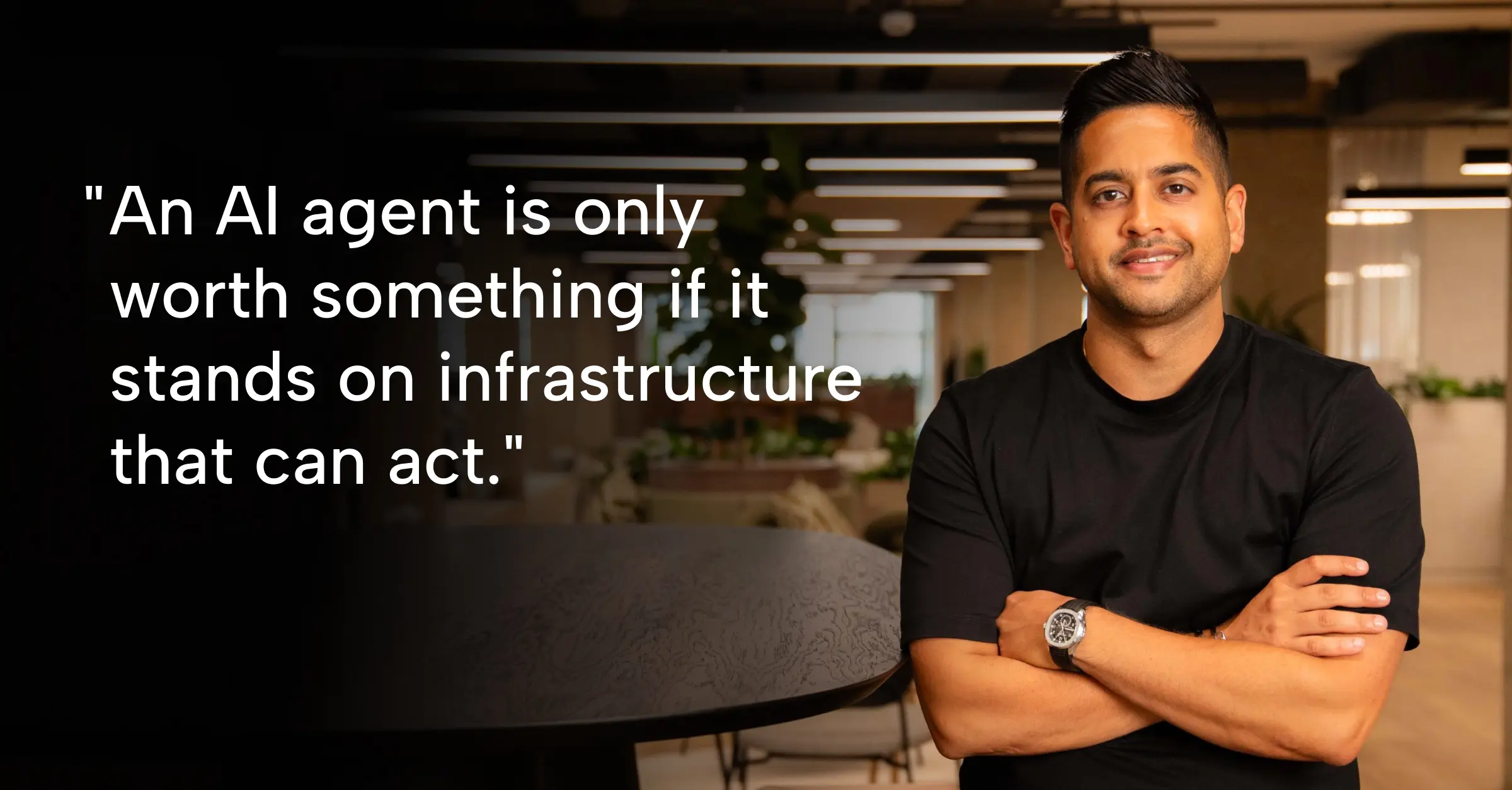
An agent that decides to fund payroll in multiple currencies still needs an account that holds them, a license that permits it, and a rail that settles it. An AI agent is only worth something if it stands on infrastructure that can act.
Just as AWS became the infrastructure layer software runs on, Sokin will become the infrastructure layer financial operations run on. Sokin will become the connective tissue between systems and agents.
The evolution towards agentic treasury
Last month, I attended an event in Florida and sat down with more than 50 CFOs from some of the world's largest companies. We surveyed those CFOs, asking them how they manage treasury today, and the answers were telling.
71% said the biggest challenge isn't just moving money, it's the manual work around it and more than half rely on eight or more platforms to understand, decide and execute their global treasury operations. Despite all the technology available, Excel is still the glue holding much of it together.
Everything is manual and slow. Agentic treasury is going to change that, becoming the operating model for finance.
The shift to agentic is not a silver bullet, though. An agent can spot an FX exposure quicker than a human, but it likely has to hand off to a separate system to act on it. An agent with no agency to act is not an agent.
Real agentic treasury closes the loop in one place: decide, approve, execute, settle, in a single data model.
We are building that in stages. In practice, this is agentic treasury in action:
First, the platform surfaces the decision: your cash is sitting idle, this payment should route this way, this exposure needs hedging. Then it recommends, and the team approves with one click, and the agent executes within limits set by the company in advance. The treasury team stops doing the manual work and starts setting the policy that the agents run inside. This is decision intelligence and it lets the finance function move from reacting to running itself between exceptions.
This is why the lifecycle on our platform now ends in a seventh capability: decide. Receiving, converting, sending, holding and earning are the things money does. Deciding is the layer that makes them intelligent. It sits on top of the other capabilities because for an agent to maximize its utility, it needs to reach into all of them at once.
That reach is another thing we are building. Using MCP, a customer will be able to connect Sokin to whatever AI tool they already use, from an LLM to their own agents, and run their money operations through natural language prompts. The agent does the work and a person still approves every payment.
And soon, a business will be able to manage daily spend on Sokin too, with corporate and virtual cards funded from the same balances, fiat or stablecoin, under the same controls.
The entire cycle of a business’s money, from the moment it arrives to the moment it is spent, sits on the Sokin platform with one set of licenses underneath it. That is the whole point of building the layer rather than the app.
What this means for our customers
If you run a finance team, all this probably sounds nice, but you’re maybe wondering how it changes your job.
You set your treasury policy once, in plain language, and from then on the system does the watching: your cash flow, your exposure, the payment that should be held or the balance sitting idle.
It brings you the decision already worked out, you review and approve, and it executes in the market at FX rates usually reserved for the largest corporates. You go from wrangling spreadsheets across five systems just to see where you stand, to approving actions that are ready when you are.
And, because we own the licenses and the settlement rails ourselves, you can move money into and out of markets that would otherwise mean another local account or another provider. As more of your work starts running through AI agents, you're already on infrastructure built for them, rather than agents bolted onto tools that were never meant to move money.
In short, treasury stops being on the back foot. It becomes something that helps the business grow and become more efficient.
Building a business for the future and beyond
I’m a lifelong supporter of Man Utd, which has recently been a long lesson of patience in and of itself!
Sir Alex Ferguson didn’t build a side to win one season, but an institution that kept winning as the money and the economics, the football and the players changed around him for 25 years. He built for seasons to come and wasn’t afraid to reinvent when he sensed change happening. That is the business I am building. I am not building a business that simply rides the current trend. I am building the bedrock through which the next transformation must inevitably flow.
Sitting here right now, I have so much confidence and conviction in where we are going. How much our business will be valued, who will be using our platform, and who we will be mentioned alongside.
Thank you to our people for their tireless work and ingenuity in building what we have today and what we will have in the future. Finally, to our clients and partners: thank you for believing in our vision and trusting us to shape the future of finance alongside you.
Onwards!
Vroon