Last updated: September 2026
Quick answer: The GENIUS Act (signed July 2025) set federal rules for who can issue a stablecoin and what reserves they must hold. The Digital Asset Market Clarity Act (H.R. 3633, known as the CLARITY Act) would go further, deciding which US regulator, the SEC or the CFTC, oversees the markets stablecoins and other digital assets trade in. As of September 2026, Clarity has passed the House but not the Senate.
For a while, the story of US stablecoin policy had one clear plot point: the GENIUS Act. Signed into law on July 18, 2025, it gave payment stablecoins their first real federal rulebook, which included reserve requirements, audits and a licensing regime for issuers. It answered the question that had followed stablecoins for years: who is allowed to issue one, and what do they have to hold behind it.
The next question is bigger, and it is still being written.
The Digital Asset Market Clarity Act (H.R. 3633, the "CLARITY Act") would decide who regulates the rest of the digital asset market, not just the entities issuing stablecoins, but the exchanges, platforms and protocols they move through. The Senate returns from recess on September 14, with a procedural cloture vote teed up for September 15. Whatever happens on that vote, the bill is not law yet, and the gap between what Genius settled and what Clarity might still settle is one business and not just Washington is working around right now.
What did the GENIUS Act settle?
The GENIUS Act was narrowly targeted by design. It covers payment stablecoins specifically: which entities can issue them, what reserves they need to hold against every token in circulation, how those reserves get audited, and a ban on issuers paying interest or yield directly to holders.
It isn't fully in effect yet, though. Regulators are still finalizing the implementing rules, and issuers have until July 2028 to bring existing stablecoins into compliance. Even so, its passage alone was enough of a signal: banks, exchanges and fintechs treated a known federal standard as reason to act ahead of the deadline.
So a business holding a stablecoin balance today is holding a token from an issuer working toward that federal standard, not necessarily one that's already fully inside it. What Genius doesn't cover at all, now or once fully phased in, is the market the stablecoin trades in: who oversees the exchange, platform, or protocol actually moving it.
The GENIUS Act showed what certainty could do
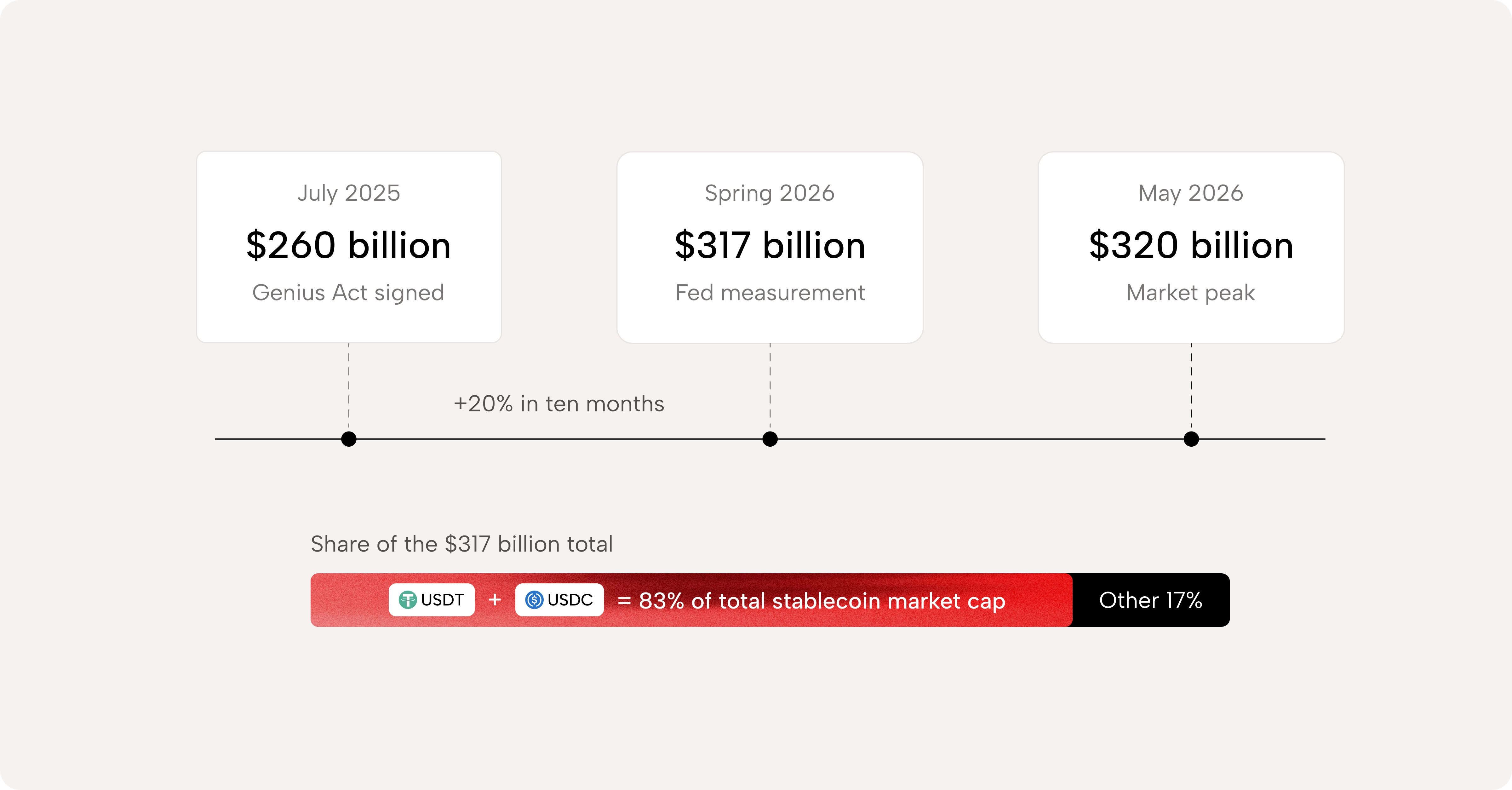
While the Clarity Act has spent over a year moving through the legislative process, the stablecoin market it would help govern has kept growing. Total stablecoin capitalization sat near $260 billion when Genius was signed in July 2025. By this spring, the Federal Reserve measured it at $317 billion, an increase of more than 20%, with the market touching a peak near $320 billion in May. Tether's USDT and Circle's USDC alone now account for roughly 83% of that total.
The growth is not just token supply. It is institutional entry:
- The Office of the Comptroller of the Currency granted national trust charters to Ripple, Fidelity Digital Assets, BitGo, Paxos and First National Digital Currency Bank.
- Tether launched a US-based stablecoin, USA₮, with Anchorage Digital Bank as issuer.
- SoFi rolled out its own stablecoin to a customer base of nearly 15 million people.
One piece of federal clarity (with a lowercase c) did all of that. It's a reasonable preview of what a fuller rulebook, one that also covers where these assets trade, could do for stablecoins and other digital assets.
What would the CLARITY Act change for stablecoins?
Clarity picks up where Genius left off. The bill would sort digital assets into categories and hand the Commodity Futures Trading Commission (CFTC) exclusive jurisdiction over spot markets in digital commodities, while the Securities and Exchange Commission (SEC) maintains oversight of securities.
Genius stopped stablecoin issuers from paying interest directly to holders, but the law didn’t apply that rule to the exchanges and platforms distributing that stablecoin. Coinbase, for instance, has paid rewards north of 4% on USDC balances, money that issuers can't legally pay. Currently, a distributor can. Clarity's current draft tries to close that gap: it bans rewards that function like bank interest, while still allowing rewards tied to genuine activity, like trading or providing liquidity. Banks argue the carve-out is itself a new loophole, since a reward based on balance size and how long you've held it can look a lot like interest by another name. It's one of the last real disagreements standing between the bill and a floor vote.
Has the CLARITY Act passed the Senate?
Not yet. The House passed its version of the Clarity acf on July 17, 2025 by a bipartisan 294-134 vote. The Senate Banking Committee advanced its version 15-9 in May 2026, and the Senate Agriculture Committee passed a companion bill in January. What has not happened is a full Senate floor vote. A failed cloture vote in September would not necessarily kill the bill, but it would make 2026 passage considerably less likely.
Why treasury teams can act today
Finance and treasury teams don't need Clarity to pass before they plan around it. But they need enough visibility into where the rules are heading so they can start building now rather than reacting later.
Sokin CEO Vroon Modgill: "Innovation moves fastest when businesses know the rules before they build, not after. Genius gave stablecoin issuers that certainty. Clarity would give it to the market they trade in. Until it does, the responsible move for any finance team is caution, not permanent hesitation, just caution until the framework catches up with what businesses are already trying to do."
So, what does operating cautiously look like day to day? Checking whether a stablecoin issuer is registered, or on a path to registering, as a Permitted Payment Stablecoin Issuer, with disclosed reserves and regular audits. Circle and Tether already publish monthly reserve attestations from independent accounting firms, so a treasury team can review those directly, the same way it would review a bank's audited financials and fold the question into whatever vendor risk process already covers banking and payments partners rather than treating it as a separate crypto-specific review.
The upside shows up most clearly in cross-border settlement.
Stablecoins settle in minutes instead of the days a correspondent-banking wire takes, and they run outside normal banking hours, which matters for a business managing international payroll or supplier payments where cash otherwise sits in transit for days.
That's the case for pairing stablecoin rails with the fiat ones a business already relies on, rather than replacing one with the other. Sokin's Hybrid Finance runs both side by side on one platform, so a finance team can use stablecoins where speed matters and fiat where it doesn't, without standing up separate infrastructure for each.
What should wait is anything that depends on stablecoin "rewards" or yield, and anything that assumes a finished rulebook for the exchanges stablecoins trade on. Both are unresolved. The rewards provision is still being negotiated in the Senate, and Clarity, which would set that broader market structure, hasn't passed.
Where this goes next
Whichever way the September 15 vote goes, the direction is already set: the federal government is working toward a comprehensive market structure for digital assets. More certainty from Washington will help the broader market mature, bringing in more institutions and more capital and reducing guesswork for market participants.
Businesses don't have to wait for the Clarity Act to pass before they start benefiting from stablecoins. The Genius Act already provides enough certainty for businesses to move forward, adopting rails that send money across borders quickly and securely. Learn more about how Hybrid Finance gives businesses access to stablecoin and fiat rails in one platform. [links to the Hybrid Finance manifesto]
The GENIUS Act answered who can issue a stablecoin. The CLARITY Act, whenever it lands, will answer who oversees the market it trades in. Businesses do not have to wait for either answer to start moving money on both rails today.
Frequently asked questions
What's the difference between the GENIUS Act and the CLARITY Act?
The GENIUS Act regulates stablecoin issuers directly: reserves, audits and licensing. The CLARITY Act regulates the broader market stablecoins and other digital assets trade in, splitting oversight between the SEC and CFTC. Genius is law; Clarity is not.
Has the CLARITY Act become law?
No. It passed the House in July 2025 by a 294-134 vote and cleared the Senate Banking Committee 15-9 in May 2026, but it has not passed the full Senate. A procedural cloture vote is scheduled for September 15, 2026.
Why did the stablecoin market grow so much in 2025 and 2026?
Federal Reserve data shows stablecoin capitalization grew by over 20%, from about $260 billion to $317 billion, in the year after the GENIUS Act was signed, driven by regulatory clarity for issuers, new bank charters and institutional entrants like SoFi and Tether's USA₮.
What is Hybrid Finance?
Hybrid Finance is Sokin's approach to offering fiat and stablecoin payment rails side by side on one platform, so businesses can use either rail without committing to one before the regulatory picture is settled.