At a recent event, our Chief Product Officer, Peter Daunton asked a room full of CFOs and COOs from large global organisations a simple question: where do global payments and treasury sit on your agenda this year?
Nearly a quarter of the room said it was their least important item. Solved. Handed off. Not worth a strategy conversation.
It's easy to think treasury is "done" once payments are flowing. But the discussion quickly revealed that what looks solved on the surface often hides operational complexity, and that complexity is exactly what stands between most finance teams and agentic treasury: a treasury function where AI can act on real-time data, not just report on it. Much of that complexity is slowing teams down in ways that aren't always visible.
Treasury may not appear to be the most urgent item on the CFO agenda. But if the priority is deploying AI to make faster, more intelligent financial decisions, treasury data and infrastructure quickly become foundational. AI cannot act confidently when information is fragmented across multiple systems, controls and providers.
Where the pain really lives
The next question in the room cut closer to the bone: where does the real problem sit in your treasury and cross-border payments operation today?
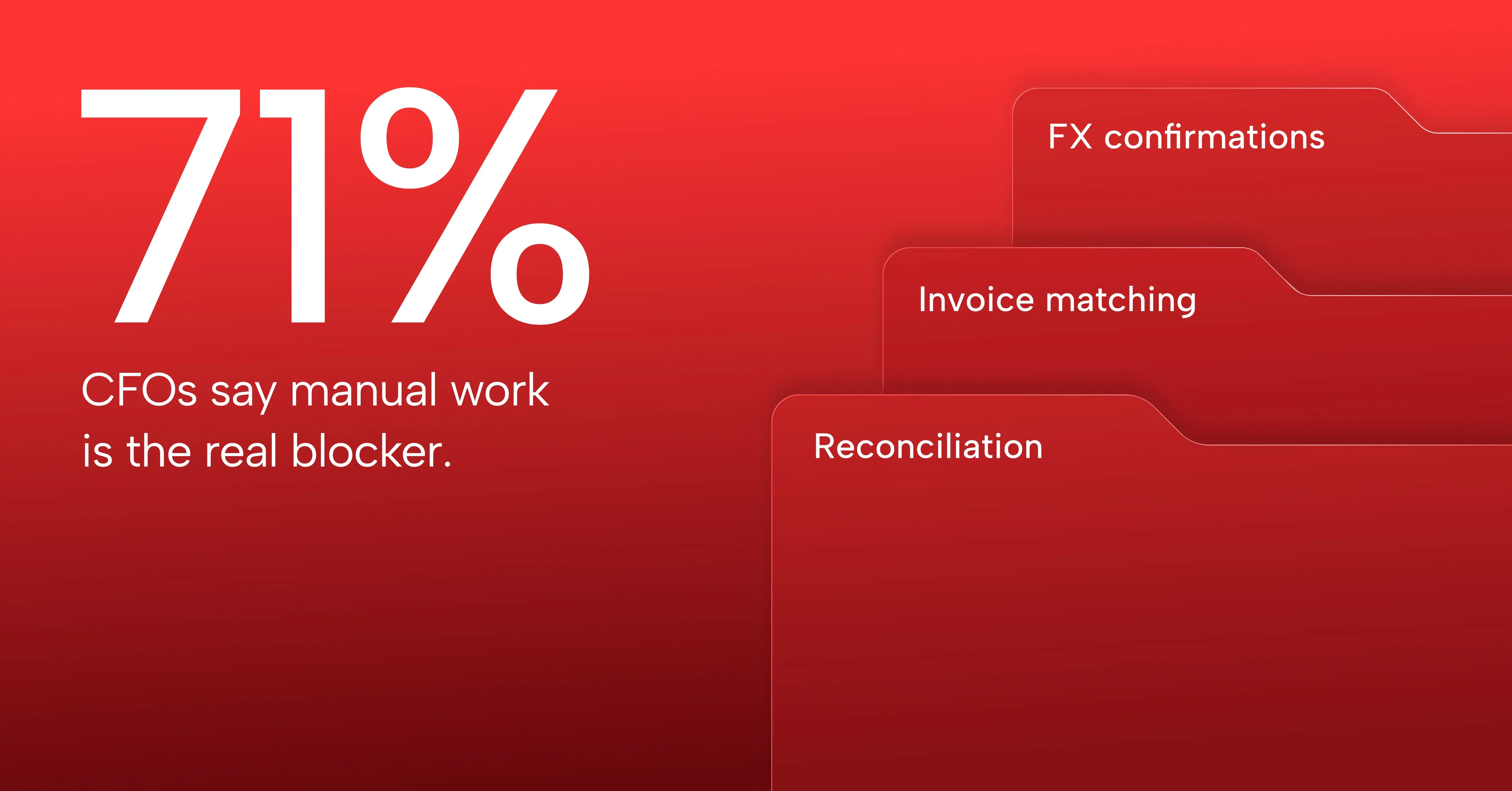
Transaction speed and cost barely registered, just 8%. Cash visibility took a slightly bigger slice at 13%, and decision lag, that moment when the information finally arrives but the window to act has already closed, came in at 4%. What dominated the answer, by a wide margin, was manual work: reconciliation, reporting, exceptions, all the unglamorous tasks that quietly drain a finance team's time until you look up and the week's gone. 71% of the room pointed to this as the real drag.
That's worth sitting with for a second. Most conversations about treasury pain focus on visible costs: FX spreads, transfer fees, and slow rails. But the people actually running these functions are saying the real tax is invisible. It's hours spent chasing down a mismatched entry or manually stitching together numbers from three systems that were never built to talk to each other.
A patchwork, not a platform
Part of the explanation showed up in the following poll. Only 17% said their setup runs on three tools or fewer. Another 29% called theirs manageable, somewhere between four and seven platforms. Then 46%, the largest group in the room, said their team relies on between 8 and 15 separate tools and providers just to run cross-border treasury: banking platforms, treasury management systems, expense tools, ERPs, FX desks, approval workflows, and the inevitable Excel spreadsheet holding it all together. A further 8% put the number above 16, and a few people admitted they'd honestly lost count.
Every one of those connections is a seam, and every seam is a place where data goes stale. Context gets lost, and somebody has to step in and manually bridge the gap. This isn't a story about treasury teams being bad at their jobs. It's a story about people doing a genuinely difficult job well, using tools that were never designed to work as one system.
So, the label "solved" is doing a lot of work it hasn't earned. Nothing about this is on fire. There's no incident report. But capacity that could go towards decisions moving the business forward is instead going towards holding a patchwork together.
AI is ready. Trust isn't
Given all that manual grind, why hasn't AI already stepped in to fix it? That's where the third poll got interesting. In this room, output quality was rarely selected as the single biggest barrier, just 4% picked it. Integration came in at 26%, and 30% pointed to something less technical: too many possible use cases and no obvious place to start.
But the single largest response, at 39%, was something else entirely: getting auditors and the board comfortable with AI influencing real financial decisions.
That's not a capability problem. It's a governance problem, and governance problems don't get solved by adding another feature to an AI tool. Agentic treasury is AI that doesn't just surface information but acts on it, within set limits. That kind of trust doesn't come free. It only comes from infrastructure that's consolidated, traceable, and built to survive being questioned by an audit committee.
What CFOs actually want AI to do first
When asked what use case people would chase first if their cross-border treasury data were fully consolidated, half the room, 50%, landed on the same answer: FX risk and hedging, with AI continuously watching exposure and recommending moves against live market conditions instead of yesterday's numbers. Working capital optimisation followed at 25%, deciding in real time whether to take an early payment discount, draw on a revolving facility, or simply hold. Real-time cash positioning wasn't far off at 21%, and only 4% went straight to predictive payment routing, letting AI pick the fastest and most compliant corridor for a transaction on its own.
The pattern underneath all three answers is the same. People don't want more dashboards. They want the gap between "something happened" and "here's what we should do about it" to shrink to almost nothing.
That gap narrowing dramatically is, in practice, what agentic treasury means: not a chatbot bolted onto a treasury dashboard, but a system that can watch exposure, judge the moment, and act, inside the guardrails a CFO actually trusts.
Solved doesn't mean simple
The uncomfortable part of all this is that treasury only feels solved because finance teams have gotten remarkably good at absorbing complexity by hand. The problem hasn't disappeared. It's just moved, quietly, from a system to a person, one reconciliation at a time.
That gap between perception and reality also explains why AI often remains at the "nice idea" stage. Fragmented infrastructure makes it difficult to trust AI with decisions that materially affect the business.
This is where Sokin fits. As a global financial infrastructure platform, Sokin helps businesses move, manage and optimise money across borders through more connected financial operations. 26 multi-currency accounts and payments in more than 70 currencies¹ using trusted local and international payment rails. Add integrations that simplify reconciliation, and the result is more visibility and less operational fragmentation.
That foundation matters because AI cannot simply be added to a dashboard. Accounts, currencies, payment flows and operational data first need to connect in a way that makes every recommendation or action traceable and defensible. More intelligent treasury starts with infrastructure finance leaders can understand, govern and trust.
Global finance runs on complexity by default. Sokin is what happens when someone removes it.
See what a consolidated treasury layer looks like for your business? Book a conversation with our team.