For many global businesses, payments no longer sit at the edge of operations. They are now central to how the business runs.
What often starts as a simple setup becomes more complex over time. A business may begin by accepting payments in a few markets. As it grows, new currencies are introduced; suppliers sit in different regions, and customers expect to pay in local currencies.
At this stage, the challenge shifts. It is no longer just about accepting payments. It becomes about how money moves across the business, and across borders:
- How funds move between currencies
- How balances are held and deployed across regions
- How payouts are managed at scale
- How financial data is reconciled across systems
This is how it usually plays out. Let's take a travel marketplace. It might start by listing hotels and managing bookings.
As it grows, it begins to take payments directly, hold funds, and pay out partners. Expansion into new markets introduces additional complexity. The business is now collecting in multiple currencies, paying out globally, and managing refunds, timing and compliance across regions.
At that point, it is no longer just handling bookings. It is responsible for collecting money from customers, holding and moving funds, and paying suppliers and partners across multiple markets.
This is why conversations around Payment Service Providers (PSPs), Banking-as-a-Service (BaaS), and embedded finance infrastructure have become more relevant. As businesses take on greater responsibility for how money moves, the underlying infrastructure becomes more important. While these options can appear similar on the surface, they are built to solve very different problems.
How payment infrastructure has evolved: from PSPs to embedded finance
To understand how these approaches differ, it helps to understand how payment infrastructure evolved.
In the early days of e-commerce, businesses primarily needed a way to accept payments online. A customer paid, the transaction was processed, and funds were settled into a bank account.
Over time, payment acceptance became only one part of the challenge. Businesses also needed to hold balances in multiple currencies, manage FX, coordinate global payouts, and move money between entities and regions.
What began as a payment problem became a financial operations problem. Different infrastructure approaches emerged to address those changing requirements.
Payment service providers and the rise of online payments
Payment service providers were designed to solve a clear problem. How businesses accept payments online. Before PSPs, connecting to card networks and processing digital transactions required direct relationships with acquiring banks, an expensive, time-consuming process that was out of reach for most businesses.
PSPs changed that by simplifying online payment acceptance through capabilities such as payment acquiring, transaction processing and checkout experiences.
This made e-commerce scalable. It allowed businesses to accept cards and alternative payment methods across markets without building their own infrastructure. However, PSPs were designed for transaction processing.
They were not built to hold multi-currency balances, manage complex payout ecosystems, or coordinate financial flows across multiple legal entities and regions. As businesses grew more global, those limitations started to show.
They solved payment acceptance very well, but they were not designed to operate as a full financial operating layer.
Banking-as-a-service and embedded banking products
BaaS emerged as businesses looked to go beyond payment acceptance and embed financial products into their own customer experiences. BaaS providers sit on top of licensed banks and expose capabilities such as accounts, card issuing and deposits through APIs.
This allows businesses to offer regulated financial products without obtaining a banking licence themselves. Because these programmes are built on underlying banking partners, expansion can depend on factors such as bank coverage, approval processes, and programme structure.
Embedded finance infrastructure as an operating layer
Embedded finance infrastructure addresses a different challenge. Rather than providing access to individual banking capabilities, it focuses on coordinating financial flows across accounts, currencies, and payment networks. This can include onboarding and compliance orchestration, multi-currency account structures, FX management, payout networks, reporting, and reconciliation. The goal is not simply to enable financial products, but to create a single operating layer that helps businesses manage financial operations across markets.
Comparing PSP, BaaS and embedded finance infrastructure models
At a high level, PSPs, BaaS providers and embedded finance infrastructure can appear similar. Many offer payments, accounts, wallets, and APIs.
The difference is not just what they offer. It is what they were designed to do.
Each model solves a different core problem. That original purpose shapes how it behaves as complexity increases.
The easiest way to see the difference is to look at how each model is built and where it starts to struggle as financial operations become more complex.
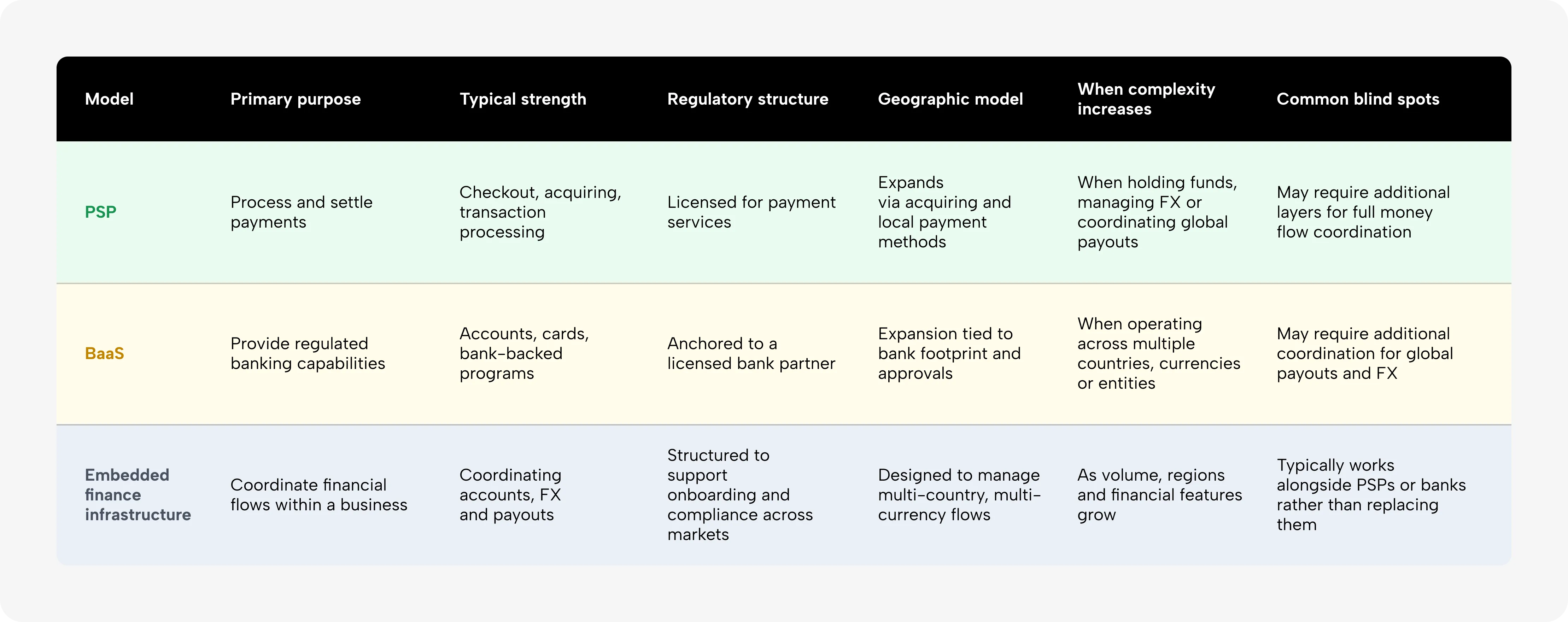
As businesses grow, these differences become more visible. What works for processing transactions may not support coordinating financial operations across multiple markets.
It is also worth noting that some providers operate across more than one layer. Capabilities can be combined depending on the architecture and the needs of the business.
In many cases, businesses use a combination of these models rather than relying on just one.
Why PSPs, BaaS and embedded finance infrastructure are often confused
One of the main reasons this topic creates confusion is capability overlap. Many providers now offer:
- Payments
- Wallets or balances
- Accounts
- Payouts
- APIs
From a feature perspective, they can look similar.
But feature overlap does not mean architectural similarity.
The key difference is design intent.
- PSPs are designed for transaction processing
- BaaS is designed to provide access to regulated banking capabilities
- Embedded infrastructure is designed to coordinate complex financial operations
The operational challenges of global payment infrastructure
PSPs, BaaS providers, and embedded finance infrastructure are designed to solve different problems.
As businesses expand across markets, the challenge often shifts from simply processing payments to managing financial operations across currencies, entities and jurisdictions.
Understanding these operational challenges helps explain why different infrastructure models exist and where each one is typically used.
Managing multi-currency payment flows
Businesses often collect funds in one currency, hold balances in another, and pay out in a third. This creates timing mismatches and operational complexity that becomes difficult to control as volumes grow.
Controlling FX exposure and timing
As financial complexity increases, a new set of operational questions emerges:
- When should conversion happen
- Who holds currency risk
- How margins are affected by FX timing
Without clear control, FX can gradually reduce profitability.
Supporting multi-entity business structures
Cross-border businesses often operate across multiple legal entities.
This creates requirements for:
- Internal fund movement
- Intercompany flows
- Segregation of funds across regions
Understanding compliance responsibilities
As financial capabilities expand, so do compliance requirements:
- Who onboards users
- Who performs KYC or KYB
- How responsibilities are shared across partners
Clear ownership becomes critical as operations scale across jurisdictions.
Reconciling transactions at scale
Businesses must manage large volumes of transactions across:
- Multiple currencies
- Different payment rails
- Several jurisdictions
This often leads to fragmented data and slower, more complex reconciliation processes.
As more money moves through the business rather than around it, infrastructure decisions become more important. What works in one market does not always support global operations.
Choosing the right financial infrastructure approach
There is no single model that fits every business.
In earlier stages, a simple payment setup may be enough. As operations expand across regions, currencies, and entities, the requirements change.
What matters is how well the infrastructure supports money moving through the business.
The right approach depends on:
- The complexity of financial flows
- The number of markets involved
- The level of operational control required
- The scale of the business
As businesses grow, money movement becomes part of how the business runs day to day. Choosing financial infrastructure is not just a technical decision.
It shapes how efficiently a business can operate, how well it can manage risk, and how easily it can scale into new markets.